University of Utah

An Interdisciplinary Academic Program in Earth Science
|
University of Utah |
An Interdisciplinary Academic Program in Earth Science |
| Bob Smith's research interests are in seismology, tectonophysics, crustal deformation using GPS (Global Positioning System), and active tectonics. Current research projects include: 1) geodynamics of and evolution of the Yellowstone hotspot and the Yellowstone caldera, 2) seismicity and volcanic hazards of Yellowstone and operation of the Yellowstone seismograph network, and 3) crustal deformation and earthquake hazards of the Wasatch and Teton faults using GPS and fault modeling. Teaching includes tectonophysics and elastic waves, theoretical seismology, earthquake seismology and earthquake hazards, and introductory earthquakes and volcanoes. See detailed information on my courses and research below. |
|
||||
 Teaching
Research
Publications
Graduate Student Research
Student Opportunities
Image Gallery
Teaching
Research
Publications
Graduate Student Research
Student Opportunities
Image Gallery
|
|
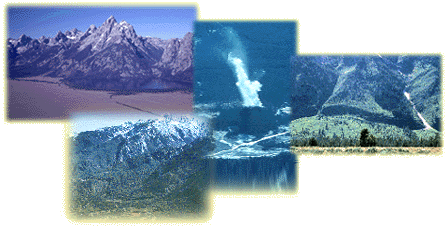 Above, from left to right: Teton Range, Wasatch Range, Steamboat Geyser, and Teton fault scarp |
|
|
|
|
|
|
|
|
|
|
Ongoing research
projects investigate not only the Yellowstone hotspot but the Wasatch Front and
Utah as well. These studies focus on fault dynamics and earthquake hazards of the Wasatch
fault, seismicity of the Intermountain Seismic Belt, and tectonics of the Intermountain
region, including the eastern Basin-Range and Yellowstone hotspot.
|
|
|
|
|
Yellowstone Volcano Observatory |
|
|
The Yellowstone Volcano Observatory (YVO) was established in May 2001 to study and monitor the Yellowstone Volcanic Field. The Observatory is a collaboration between the University of Utah, the U.S. Geological Survey, and Yellowstone National Park. For more information, visit
| |
|
|
|
|
Bob Smith may be contacted at: email: robert.b.smith@utah.edu | |